
Projects
Filter Projects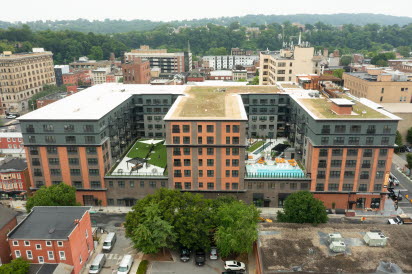
Marquis Parking Garage
The landmark 400,000-square-foot mixed-use development features seven floors, 264 apartments, first-floor retail, a green roof, and a 308-space parking deck. As the largest residential project in Easton's history, it required a construction strategy that could deliver speed, structural performance, and architectural cohesion. Precast concrete was selected for the two-story parking garage, which serves as the structural base for the five-story steel-framed apartment complex above.
The garage is wrapped on two sides with commercial space, the precast walls providing essential three-hour fire-rated separation between these areas. Two elevations are clad with cast-in ThinBrick to match the apartment façade, helping the garage visually disappear into the building and meet the local architectural board’s expectations for masonry articulation and urban integration.
Drosdick Hall Villanova Univeristy
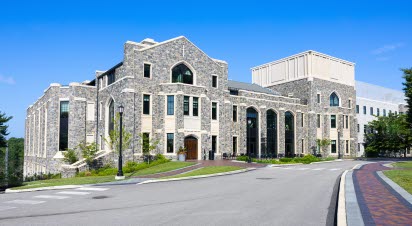
This ambitious and forward-thinking expansion of a university’s college of engineering more than doubled its main academic space, creating a transformative new home for the entire engineering community. The project features over 20 new research laboratories, expanding lab space by more than 60 percent. A two-story innovation lab is equipped with 3D printers, laser cutters, and workspaces for student projects, such as the Formula SAE car. The building features green roofs with intelligent monitoring systems, serving as both sustainable infrastructure and live research tools. These tools gather real-time climate and soil moisture data, helping to teach students about stormwater management.
A three-story atrium creates a central area for collaboration and studying. The building also contains cutting-edge instructional spaces designed for hands-on, team-oriented learning, as well as dedicated spaces for master’s and doctoral students to strengthen the academic community.
40th Precinct
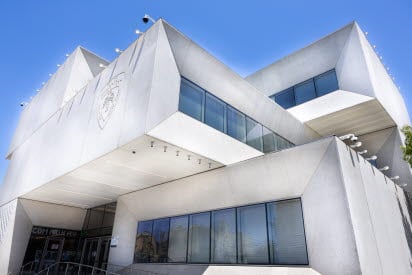
The 40th precinct station in the Bronx, New York City, evolved from a decades-long design process, undergoing numerous iterations before reaching its final form. The building’s architecture features a series of stacked box sections, creating dramatic overhangs and walls that give it a bold, modern look. This building encourages community engagement while providing a secure space for its officers to work and train.
Precast concrete visually connects the new precinct with the historic character of early city station houses. The alternating polished and light sandblast finish allows the building to seamlessly blend into the surrounding urban landscape while asserting a contemporary presence. The entrance stairs and benches were also constructed using precast concrete, ensuring consistency in material and design throughout the site. The overall box-and-brick design was tailored specifically to meet the city’s programming and operational needs, striking a balance between civic presence and functional performance.
JP Morgan Chase Parking Garage
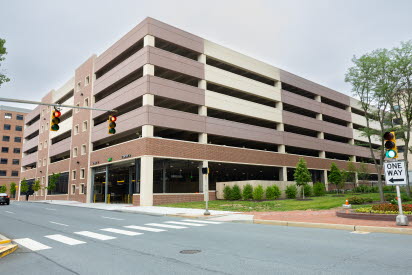
Located in the heart of Wilmington, Delaware, this precast concrete parking garage was designed to consolidate staff parking from multiple remote locations into a single, efficient, and secure on-campus structure. While functionality and speed were key drivers, sustainability quickly became a defining feature. A significant achievement was the late-stage integration of Pozzotive®, a post-consumer recycled glass material used as a partial replacement for cement in the structural precast mix. Although not part of the original plan, JPMorgan Chase's commitment to environmental responsibility sparked a collaborative effort to test and implement this innovative material. The result: a 25% reduction in cement content, significantly lowering the project’s carbon footprint. This effort involved extensive R&D, coordination with caulking suppliers, and the development of preliminary Environmental Product Declarations (EPDs) to ensure performance and compatibility.
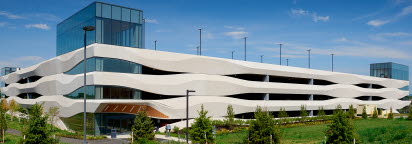
Penn State Hershey Campus Parking Garage
Inspired by the rolling hills in Pennsylvania, the eye-catching waving spandrels are the first element to greet you as you drive onto the health campus and the last you pass as you leave. Being in such prime real estate, the owners did not want this to be an ordinary parking garage. The Architects took on the challenge with inspiration from the land around them and created a total precast concrete marvel with 1,235 parking spaces with room to expand as needed.
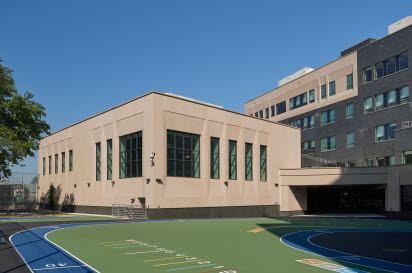
Public School 667
As demand for updated schools continues to grow in a major metropolitan area, city construction administrators are seeking new solutions to modern issues that existing structures simply can’t address. In a dense urban location, speed and efficiency of construction is a necessity, but a school must also be safe and strong to act as a safe haven for the community, with the ability to last for years to come. Through a collaborative design-build process, our company was tasked with constructing a new K-12 public school in this urban area. This project was one of the first large-scale precast concrete projects taken on by the school’s authority, with precast selected in lieu of typical block, brick, and mortar due to a tight construction site with the surrounding urban environment and limited timing due to the school year's schedule. The new school’s construction included a combination of insulated, spanning, and brick-clad precast panels intended to both blend into the historic neighborhood and act as a modern representation of the surrounding community.
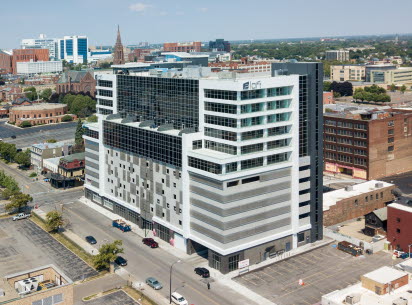
500 Pearl Street Parking Garage
Perched up above a seemly 6-story precast podium parking garage stands a hotel and apartments that rely on the durability of precast to provide key functionality to the structure. While the garage is an open design for natural ventilation, the designers observe a balance using large wall panels with a square reveal to create the visual of sectioned windows on a standard building. Being able to factor in the finished material by augmenting another material elevated off the precast panels was a benefit to using precast concrete on this project to create the feel of a cohesive building and not a parking garage.
The precast columns stream down through the 380 car parking garage into the ground level to structurally support the garage as well as the steel structure placed above the garage. The structural capacity and durability precast brings are essential to the harsh weather climate that this structure will come into play with.
The first level of structural elements complements the functionality of the building ground level by acting as a ceiling that completely seals an operational facilities portion of the hotel and several retail/food services tenants. A waterproof sealant was applied to the structural elements on the first precast level to keep the moisture out.
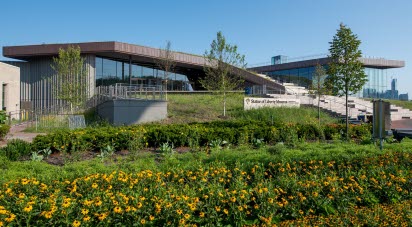
Statue of Liberty Museum and Screening Facility
At this iconic location, now stands resilient structures that are dynamic in expression and were inspired by the irregularity of the water’s edge, as well as the geometry of the circular Flagpole Plaza. This is a one of a kind museum and screening facility that leads precast structures into a new level of strength and beauty.
Merging building into the landscape, the design eschews formality in favor of an asymmetrical design that embraces its dramatic setting and changes of form as visitors move around it. The vertical patterning of the precast concrete sandwich panels was inspired by the Palisades cliffs along the Hudson River. The project’s materials link the future of the Island with its past. Inspired by the idea that the museum has been “lifted” from the park, all vertical surfaces are rendered in irregular, vertical patterns suggestive of a tectonic shift; they provide a compositional counterpoint to the building’s dominant horizontality. The precast concrete panels have a deeply textured, irregular pattern, which creates dramatic shadows; this texture reflects the Palisades cliffs of New Jersey.
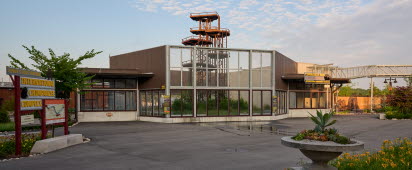
Indianapolis Zoo Chimpanzee Exhibit
When the Indianapolis Zoo planned a new chimpanzee exhibit, they needed a building material that could withstand the chimpanzees’ curious nature and tendency to dig at weak points. Precast concrete was selected for its ability to meet both structural and aesthetic requirements.
The exhibit features three distinct areas for zoo guests to interact with the chimpanzees: the arena, the cognition building, and the main entrance. Designed to house up to 30 chimpanzees, the exhibit replicates key aspects of their natural habitat. Precast concrete was chosen for its cost-effectiveness and visual appeal. Chimpanzees are naturally inquisitive and prone to digging when they find openings. The smooth back finish of the precast panels prevents the chimpanzees from causing damage.
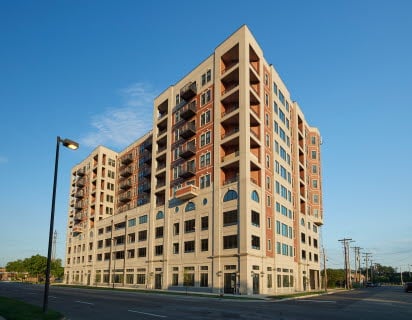
Commerce Center
As part of their large, strategic plan to attract new business activity and increase the local community’s population by 11%, a mid-sized Mid-West city planned to redevelop an underutilized downtown parking lot into a mixed-use structure. Located within an up-and-coming community along the river, the proposed live-work-play structure was intended to complement the vibrant art scene, great local dining options, and abundant surrounding recreation and athletic activities. Excited by the potential of this project, the regional development authority secured funding for the project, motivating local officials to get permits and begin work as soon as possible. The mixed-use building included ground floor retail space, attached three levels of parking, and six floors of residential apartments. Intended to become the heart of the new community, the structure was designed with longevity and a classic design aesthetic in mind. This project was originally designed as hand-laid brick and block construction around a cast-in-place concrete frame. As construction began, this design proved to be challenging, costly, and time-consuming. An extremely tight construction site and the state of community relations made setting up appropriate scaffolding for the masonry work nearly impossible. Seeing these complications, the plan was modified to use insulated precast concrete panels with thin brick. The conversion to precast concrete resulted in both time and money savings, but it also helped to maintain strong community relations by causing limited construction disruption.
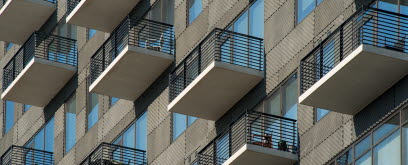
80 on the Commons
The playful yet sophisticated use of a herringbone pattern results in a standout, bold style that NBBJ wanted to capture on this civic asset in the city’s central open space.
Continuing in the style of the black façade on the top eleven stories, the white panels at ground level begin with linear lines and gradually fade to a smooth finish. The transition from a smooth finish to a heavily textured panel gives the ground level a clean ordered look in contrast to the beauty of the organized chaos above. The white mix used as the deep contrast is captured throughout the façade from the balconies to the back of the building’s recessed design were all achieved using precast concrete.
Scattered among the levels are cantilever balcony decks protruding straight out from the structure of the building. No support brackets or elements are needed for these precast slabs due to the design, therefore providing the visual of a floating deck. The severe contrast of the two colors helps deliver the architect's design intent.
The result of the refined material palette and texture of the pattern used is one of the unique features of the building. The custom formwork makes the surface appear as if it is changing throughout the day due to the shadow with the sun. Depending on the angle, the layout gives off an impression where sections appear as different shades of a black concrete mix, when in fact, it’s not.
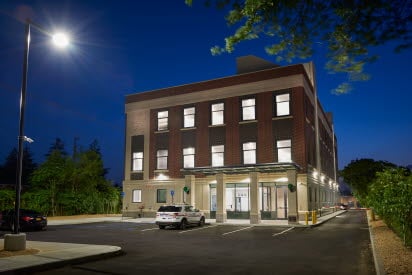
Nassau 8th Precinct
Following Hurricane Sandy in 2012, many structures owned by Nassau County in New York state were evaluated for structural damage, including the police precincts. Prior to the storm, several of these buildings had already been in need of renovations to accommodate a growing police force and resolve problems of aging infrastructure, and the storm accelerated this need, says Gilbert Balog of LiRo Architects + Planners.
In the 8th District, Nassau County wanted to replace the 1950s-era frame and brick precinct buildings with structures that communicated civic pride and could withstand the onslaughts of future major events. “Resiliency was a major factor in the selection of precast concrete construction,” says Dianne Pohlsander, design architect for LiRo. “In fact, everything came together with precast concrete: resiliency, fabrication that wasn't weather dependent, constructability, and the desired aesthetics.”
Precast concrete also helped address unique logistical challenges on this project. Construction was constrained by long and narrow site, and, because the new precinct house was constructed at one end while the old building stayed open for operations at the other, the team was under pressure to complete the project quickly with minimal site disruption. “Precast concrete gave us that quick erection time that we needed,” Pohlsander says.

Christ Hospital
In 2012, the Christ Hospital Network in Cincinnati, Ohio, decided to add an orthopedic center of excellence to its already nationally renowned healthcare facility. The owners worked with an architect to design the seven-story, 381,000 ft2 LEED Silver-certified Joint & Spine Center, which linked it directly to the hospital’s existing surgical and imaging areas.
As part of the broader master plan, the client and architect agreed that the design for the Joint & Spine Center needed to reflect the historical redbrick vernacular of the other campus buildings. It also had to meet strict budget restrictions, deliver a watertight building envelope, and meet the high-performance goals set for the new building. All of these requirements would be met with a precast concrete design.
CCHS Wilmington Visitors Parking Garage
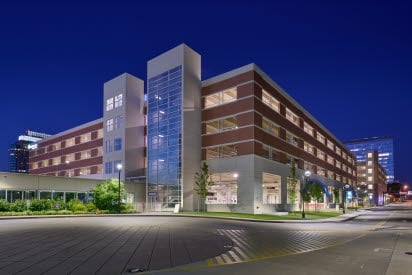
As the use of a structure changes over time, the facilities themselves must adapt. Sometimes, this means fully demolishing an existing structure to accommodate the evolving needs of its tenants. This was the case at a regional medical center, where plans were made to replace a parking garage to increase capacity and functionality. The project would feature six levels and a total of 851 parking spaces along with the construction of medical offices within the new structure. The medical center also wanted to design their new garage with flat levels so patients with mobility issues could easily access the main buildings without having to navigate ramps or stairs. It was crucial to avoid disruption of hospital access for employees and patients during construction. The bulk of this project also happened to take place during the peak of a pandemic, meaning that the hospital had higher traffic and that it was even more important to minimize disruption of the medical center’s activity.
UPMC Pinnacle Health
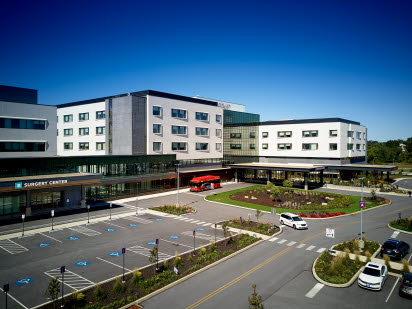
The UPMC York health campus is home to three precast concrete enclosed buildings. These buildings have very similar qualities to each other but stand alone. Each building has the same color scheme using a light color with a sandblasted finish and a dark charcoal color with a duxberry formliner.
The hospital contains more individualized rooms where each window is framed with a unique precast portion that protrudes out. The elevation around the windowsill grows from a flat side to about a 3-inch elevation on the other side. This creates beautiful shadows framing the windows themselves.
The surgery and cancer center is more of a full-floor unit. You can identify this portion by the picture frame windows that span the whole floor. These windows also have projections, but they run from top to bottom compared to the hospital windows that run left to right.
The last building on the campus is the central utility plant. This building is home to all the HVAC and generators to support the other two buildings. With the exposed roof and design of the hospital and the surgery and cancer building, they did not want to house these items on the roof of the buildings. As a result, the facility nearby houses all that is needed to help maintaine the other two buildings.
Terminal A Parking Garage at Newark Liberty International Airport
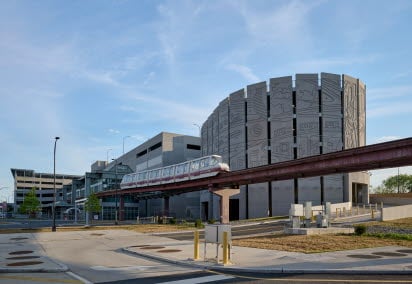
When a new multi-use parking garage was needed at the Newark EWR airport, the New York/New Jersey Port Authority explored various building solutions and ultimately chose precast concrete for its ability to meet the unique needs of this one-of-a-kind parking garage. The garage's design allows natural ventilation, and provides convenient public parking, access to all car rental companies, and solar panels in one centralized location. The garage needed to support both public and private parking for the new airport terminal and consolidate rental car facilities for the airport.
With a focus on sustainability becoming more important in new construction, the design of the parking structure needed to support the weight of 12,708 solar panels, that cover 364,00 square feet, and generate enough electricity to power 800 homes. Precast concrete was the best choice for the structure because it can handle the weight of the largest single solar rooftop of any United States airport.
The facility also features 150 electric vehicle chargers available for public use.
The garage is composed of 6,344 pieces including four helixes. An exterior ramp which connects the ready return and public parking as well as the quick turnaround portion of the garage. The ready return has approximately 5,000 parking spaces and the quick turnaround adds an additional 904 spaces.

University of Pennsylvania Health Sciences Tower
Pulling in the beauty of what the sun can do to a building, the designers captured the memorizing angles consistently throughout the self-cleaning, TX Active white cement mix. The primary design objective was to create a signature architectural building using precast while maintaining a strickt budget. This 10-story 36,735 square foot precast facade was designed with folded triangle faceted insulated wall panels, angled decorative fins, and a deceptive fold from top to bottom of this building. Two of the full precast sides of the building assimilate two large triangles meeting together on one of the three sides. At the seam where those sides meet, the panels either cascade in or out depending on the side you are viewing. The angled decorative fins sit vertically along the outside of windows. These three-dimensional fins rotate the angular peeks from one vertical row to the next. Building the illusion of depth and complexity on the building, this eye-catching feature cannot go unnoticed. Energy efficient faceted wall panels might seem to take a back seat in this beautiful design. With the details in depth created with the folded triangular pattern along these narrow wall panels your eye goes directly to them. This building, built with LEED silver certification contingency, was designed to withstand the future 10 floor addition. A mirrored image of the building standing now will be placed above the existing structure.
Riverside Hospital Neuroscience Tower
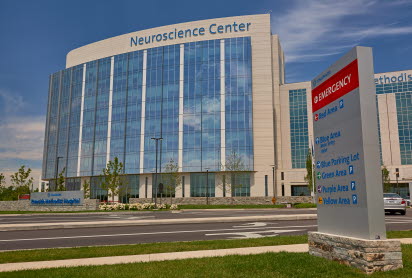
The Riverside Hospital Neuroscience Tower project is a 10-story, 437,000-square-foot addition to an Ohio Health campus. The project is the only one of its kind and is a state-of-the-art, world-class brain and spine care destination. The project includes 224 private rooms and a large interior atrium the size of two full-size basketball courts.
The exterior features 72,390 ft2 white, precast concrete panels as well as a series of blue-tinted, vertical windows. This was done to resemble the other buildings on the campus. These buildings were built at different times, with different materials, but many feature white brick walls surrounding vertical rhythms of windows. “We wanted to stay away from bricks,” said the architect. “They have an institutional connotation and can make a building appear bigger.”
Precast panels were utilized on the exterior of the building to cover a substantial portion of the facade. Precast was also used to clad a large portion of an interior courtyard that began at the third level of the structure with a rooftop green space/garden area and concluded seven stories higher at the penthouse level.
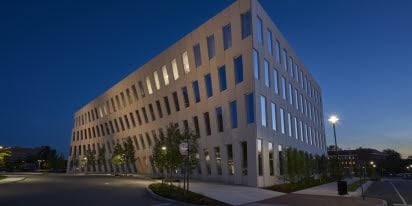
1200 Intrepid
2016's Harry H. Edwards Industry Advancement Award winner proves that precast concrete enables the most innovative architectural designs while providing a highly energy-efficient and durable envelope. One of the most prominent features of the building is the white precast concrete façade, which dips dramatically away from the walkway along the eastern edge, then tips back out again, much like the buildings in a Dr. Seuss story. “One of the key design challenges was to create that curved façade from precast panels,” says David Bosch, engineering team leader for High Concrete Group. The curved load-bearing design was achieved by assembling flat, traditional precast concrete panels to form a complex faceted geometry. An interlocking structural system was embedded within the panels to eliminate the need for traditional precast concrete spandrel panels. “The resulting façade creates an aesthetic versatility that is unique to the project,” Bosch says.
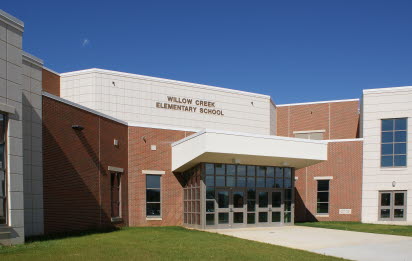
Willow Creek Elementary
The two-story, 108,000 ft2 Willow Creek Elementary School was built in response to increased enrollments at the elementary school level. The school opened for the 2009-2010 academic year and features 44 classrooms, a cafeteria, gymnasium, library, computer labs, art, and music classrooms for an estimated 700 students.
The $22.1 million school was designed by AEM Architects, Inc., which also designed the nearby Tilden Elementary Center in Hamburg, PA with CarbonCast High-Performance Insulated Wall Panels. The Tilden school was completed in 2007.
Willow Creek was built in proximity to other Fleetwood facilities and takes the place of an older block and brick structure. According to AEM project architect Justin H. Istenes, the insulated wall panels were chosen for the school because “precast is built to last. The owners toured High’s Denver plant and the Tilden school while it was under construction, and were satisfied they were getting better value with precast insulated wall panels.”
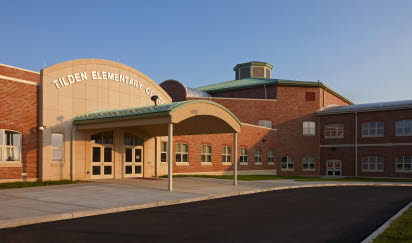
Hamburg Elementary School (Tilden)
An outstanding thermal performance was achieved at Hamburg Elementary school (Tilden) with CarbonCast walls. Amid skyrocketing energy costs and heightened public awareness of green construction practices, more building owners are seeking environmentally friendly solutions without incurring higher costs.
Tilden Elementary Center in Hamburg, PA, is no exception. The school for kindergarten through fifth-grade students will save on heating and cooling costs with innovative precast high performance insulated wall panels engineered, manufactured, and erected by High Concrete Group.
High Concrete’s 10”-thick precast exterior walls on the 110,000-square foot project delivers R-15 performance. They use three inches of continuous XPS insulation (“ci” as defined in ASHRAE Building Energy Code 90.1-2007) sandwiched between a 4” interior wythe and a 3” exterior wythe. C-GRID carbon fiber shear grid connects the two wythes. With relatively low thermal conductivity, the carbon fiber prevents thermal transfer, virtually eliminating hot and cold spots on the interior wall preserving comfort for students.
High’s precast walls helped keep the project on schedule and under budget, both of which are critical for a public school. The project was completed in June 2008—in plenty of time for teachers to welcome students for the first day of school.
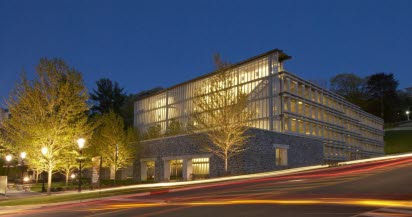
Lehigh University Alumni Parking Garage
A design-build approach that reused steel forms from an award-winning project resulted in the 315-space Lehigh University Alumni Parking Garage in four to six months less time than typical construction. The form design was recognized with a PCI Design Award in 2002 and again in 2007 when it was repurposed for this project.
The five-level, 104,000 square foot garage for university faculty features 10- by 30-foot precast concrete elements that incorporate slender precast concrete columns and spandrel beams. The structural design eliminated tall, heavy spandrels that are traditionally associated with parking structures, replacing them with an open, lightweight concrete latticework that provides both exciting form and efficient function. The panels' slender columns correspond individually to the 7-foot 6-inch span of the 15-foot-wide structural double tee stems. In addition to bringing in light and providing an open, airy feel, the exterior lattice system blocks headlight beams from reaching into the neighborhood.
Red Rose Parking Garage
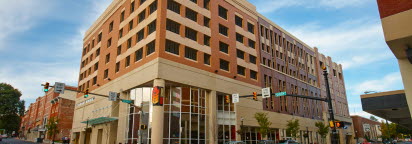
Once bustling with retail business and pedestrian traffic, the City of Lancaster, PA is working toward rebuilding a vital and vibrant downtown. Designed with an intention to stimulate the Lancaster economy with much-needed commuter and transient parking and 15,000 square feet of retail space on two floors, the 185,000-square-foot Queen Street Station Parking Garage complements the city’s historic streetscapes and creates a pedestrian-friendly aesthetic.
Mercy Health West Hospital
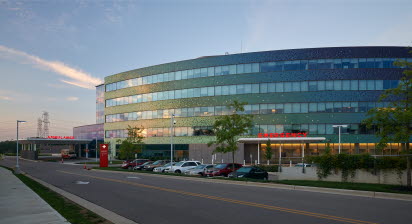
Opened in fall 2013, Mercy Health - West Hospital brings a new level of healthcare to Cincinnati's west side. The 625,000sf project features 250 beds, comprehensive cardiac care, an oncology treatment center, a maternity and birthing center, and Ohio's largest green roof. The medical facility eliminates the need for the local residents to travel outside of the area for full-service medical care.
The medical facility features state-of-the-art care combined with amenities that focus on the patient and their families to create a comfortable and healing atmosphere. This approach to health care architecture, balancing beauty, culture and function set a new standard for hospital design. Connections between architecture, natural light, and landscape promote healing.
Located on a 60-acre wooded site, the hospital's large diagnostic and treatment base is designed to co-locate surgery, imaging, the emergency department, and cardiovascular ICU. Two-bed towers sit on this platform, which features a living roof covered with native plants — providing an ever-changing view from the patient rooms above.
The unique, 107,000sf green roof covers 2.5 acres and has more than 65,000 plants. Patients and visitors can enjoy views of the roof from the patient towers, as well as an observation area. The roof helps maintain cooler building temperatures during summer months, while capturing and holding 75% of rainwater, thus lessening the amount of stormwater run-off.